
Enzyme Knowledge Hub · Deep dive 01
Cellulase: structure, mechanism & industrial significance
From the biology of cellulose breakdown to the enzyme systems used in research and industry. Explore classification, molecular properties, natural origins and the discoveries that shaped the field.

Loading experimental protein structure…
Drag to rotate · Scroll or pinch to zoom
One protein chain · GH12 · 1.9 Å X-ray structure
Structure & publication ↗ · Download PDB ↗This is a characterised cellulase example, not a structural identification of the commercial preparation.
What is cellulase?
Cellulase is the name given to enzymes that hydrolyse cellulose, the β-1,4-linked glucose polymer that provides mechanical strength to plant cell walls. In formal enzyme nomenclature, EC 3.2.1.4 describes endoglucanase activity. In industrial practice, “cellulase” can also describe a preparation containing several complementary activities.[1]
This distinction explains why one cellulase preparation may rapidly reduce viscosity while another is better suited to releasing fermentable sugars. A defined protein, a fungal enzyme secretome and a formulated commercial blend are different materials; they should not share a single assumed molecular weight or subunit count.
Core properties and EC classification
| Property | Scientific interpretation |
|---|---|
| Enzyme class | Hydrolase; glycoside hydrolase. EC classification describes the reaction; GH family classification describes sequence and structural relationships. |
| Substrate | Cellulose and, for some endoglucanases, additional β-glucans. Specificity must be checked for the individual enzyme.[1] |
| Products | Shorter cellulose chains, soluble cellodextrins and/or cellobiose; glucose production depends on the enzyme system and β-glucosidase contribution. |
| Molecular weight | No single value for the class. Representative characterised proteins and catalytic cores are compared below. |
| Subunit structure | Examples include monomeric fungal enzymes and organised bacterial multienzyme complexes. A mixed enzyme preparation is not itself a protein oligomer.[4], [5], [9] |
| Cofactors | The classical hydrolytic mechanisms discussed here use catalytic amino-acid side chains and water. Cofactor requirements and stabilising metal effects must be assessed enzyme by enzyme. |
| pH and temperature | Depend on source, sequence, formulation, substrate and assay duration. An activity optimum is not a guarantee of stability throughout a long incubation. |
| Activity | EC number | Main role |
|---|---|---|
| Endoglucanase | 3.2.1.4 | Cleaves internal β-1,4 linkages in suitable glucan chains. |
| Non-reducing-end cellobiosidase | 3.2.1.91 | Releases cellobiose from the non-reducing end. |
| Reducing-end cellobiosidase | 3.2.1.176 | Releases cellobiose from the reducing end. |
| β-Glucosidase | 3.2.1.21 | Hydrolyses suitable β-glucosides, including cellobiose for appropriate enzymes, to release glucose. |
Historical names and older database entries can use different cellobiohydrolase conventions. Match an EC assignment to the experimentally established reaction and chain-end specificity.
Molecular weight: monomer, dimer or multimer?
There is no universal “cellulase oligomer”. A monomer has one protein subunit; a dimer has two; a higher oligomer contains more. Many familiar fungal cellulases act as individual proteins, while some bacteria assemble different enzymes on a scaffold into a cellulosome.[4], [5], [6], [9]
| Representative enzyme | Reported mass / construct | Assembly and interpretation |
|---|---|---|
| T. reesei Cel12A Endoglucanase III, GH12 | 24.5 kDa; 218-residue enzyme in the published structural study. | Monomeric biological assembly in PDB 1H8V. This enzyme lacks a cellulose-binding module.[9] |
| T. reesei Cel6A / CBH II Catalytic core | 39.06 kDa; 365-residue core in PDB 3CBH. | Monomer. The core excludes parts of the intact modular protein; this is not a full-length product specification.[5] |
| T. reesei Cel7A / CBH I Catalytic core | Approximately 46 kDa per core chain; 434 residues in PDB 1CEL. | Monomeric biological assemblies. The entry contains two core copies; its total structure weight is not one enzyme’s mass.[6] |
| C. thermocellum cellulosome | Large, heterogeneous assembly; not one fixed cellulase molecular mass. | Multienzyme complex with multiple protein components, distinct from a simple homodimer.[4] |
Report the organism, protein identifier and construct whenever quoting molecular mass. Glycosylation, signal-peptide removal, linkers, binding modules and purification can change the observed mass. SDS–PAGE estimates subunit size under denaturing conditions; native assembly requires additional evidence, such as SEC–MALS or analytical ultracentrifugation.

Natural sources and fermentation hosts
Cellulolytic enzymes occur in multiple biological lineages. There is no single original source organism for all cellulases. For a named enzyme, the natural source is the organism from which its sequence or activity originates; the production host is the organism cultivated to manufacture it.
| Organism or system | Natural / biological context | Production relevance |
|---|---|---|
| Trichoderma reesei | A biomass-degrading filamentous fungus. The QM6a lineage was isolated in the Solomon Islands during World War II. | A major industrial host for secreted cellulase cocktails; improved strains include RUT-C30 and engineered descendants.[10], [11] |
| Aspergillus niger | A filamentous fungus with extracellular plant-polysaccharide-degrading activities. | An alternative fungal cellulase producer; studied both alone and alongside T. reesei.[14] |
| Clostridium thermocellum | A thermophilic anaerobic bacterium with a cellulose-binding multienzyme system. | An important model for cellulosomes; it should not be assumed to be the manufacturing host of a fungal cellulase product.[4] |
| Recombinant host / donor combination | The enzyme gene and the cultivated organism can have different origins. | For example, a Talaromyces emersonii β-glucosidase has been expressed in an engineered T. reesei production strain.[11] |
Typical fungal manufacture uses controlled aerobic fermentation, often in submerged fed-batch culture. Strain selection, secretion capacity and the feed regime influence both yield and the enzyme balance. The resulting preparation is recovered and formulated for its intended use.[11]
The current Scientific & Technical Cellulase listing does not identify a specific source species or production strain. The organisms above are scientific and industry examples, not an attribution of this product’s manufacturing origin.[15]
Reaction mechanism: how cellulose is broken down
Each hydrolytic cleavage consumes water to split a glycosidic bond. Endoglucanases create internal breaks; cellobiohydrolases release cellobiose from accessible chain ends; suitable β-glucosidases convert cellobiose into glucose. Complete conversion therefore depends on complementary activities and access to the solid substrate.[1], [2], [3]
Retaining and inverting pathways
In a retaining glycoside hydrolase, two displacement steps preserve the anomeric configuration overall. A catalytic nucleophile forms a transient glycosyl–enzyme intermediate; an acid/base residue assists departure of the leaving group and then activation of water. Covalent-intermediate trapping provided direct evidence for this chemistry in Humicola insolens Cel7B.[8]
Inverting enzymes achieve net inversion through a different catalytic route. The reducing-end cellobiohydrolase CelS is a documented inverting example; mechanism cannot be inferred simply from the label “exo-cellulase”.[EC entry]
Why protein architecture matters
The open substrate-binding cleft of T. reesei endoglucanase I accommodates internal regions of a glucan chain. In Cel7A, loop regions create a tunnel around the substrate, supporting progressive chain processing. A cellulose-binding module, when present, helps associate the enzyme with its substrate; it is a domain, not an extra protein subunit.[6], [7]
For a finite chain containing n glucose units, complete hydrolysis can be expressed as:
This is an overall mass-balance description for complete saccharification, not the single-step reaction of an isolated endoglucanase.
Discovery and scientific milestones
“Who discovered cellulase?” requires a more precise question: first observed cellulose digestion, first isolated an active preparation, or first characterised a specific protein? A single discoverer would obscure those distinctions. The milestones below identify named contributions; the 1950 study is a foundation of the modern enzyme-system model, not a claim that cellulolysis was first observed that year.
Reese, Siu & Levinson — the enzyme-system concept
Elwyn T. Reese, Ralph G. H. Siu and Hillel S. Levinson investigated soluble cellulose derivatives and their relationship to cellulose hydrolysis. Their work helped frame cellulose breakdown as the action of cooperating components.[3]
Lamed, Setter & Bayer — the cellulosome
Raphael Lamed, Edna Setter and Edward A. Bayer characterised a cellulose-binding, cellulase-containing complex in C. thermocellum, establishing a different organisational strategy from freely secreted fungal enzymes.[4]
MacKenzie and colleagues — a trapped catalytic intermediate
A covalent intermediate in H. insolens Cel7B helped establish the retaining GH7 catalytic pathway.[8]
Martinez and colleagues — the genome of an industrial producer
The T. reesei genome study connected its enzyme repertoire with biomass degradation and provided a basis for strain engineering.[10]
Fonseca, Parreiras & Murakami — production-strain engineering
Combined genetic changes and fermentation development improved secretion and enzyme balance in a RUT-C30-derived platform.[11]
Major industrial and research uses
| Use case | Purpose of cellulase | What determines success |
|---|---|---|
| Biomass and bioethanol | Release sugars from prepared cellulosic feedstocks for subsequent fermentation. | Substrate accessibility, enzyme balance and sugar yield at relevant solids loading.[10] |
| Textile finishing | Modify cotton surfaces and reduce pilling through controlled hydrolysis. | Match the enzyme to the finish and monitor strength loss; purified cellulases can affect fabrics differently.[13] |
| Textile-waste recycling | Convert cellulose-containing waste into soluble sugars. | Fibre composition, dyes, pretreatment and achievable conversion; this remains an active development area.[14] |
| Food and beverages | Assist breakdown of plant cell walls during extraction and processing. | Use a suitable food-grade preparation and assess the actual yield, texture and filtration outcome.[15] |
| Paper, pulp and materials | Investigate controlled fibre modification, processing and cellulose-derived materials. | Preserve the properties required in the final material; the desired outcome may be limited modification rather than complete digestion.[15] |
| Academic research | Study structure–function relationships and cellulose-degradation pathways. | Use defined enzymes when assigning a mechanism or measuring intrinsic kinetics.[5], [7], [9] |
Application lesson: maximum sugar release is not always the objective. A textile-finishing treatment and a biomass-saccharification process can require very different degrees of cellulose hydrolysis.[10], [13]
Activity assays and interpreting experimental results
An enzyme unit is meaningful only with an assay definition. Record the substrate, pH, temperature, reaction time and analytical endpoint. A carboxymethylcellulose assay mainly probes activity on a soluble cellulose derivative; filter-paper assays assess a different substrate and overall system performance. Their units are not interchangeable.[12]
Reducing-sugar assays measure a combined signal from reducing products; they do not uniquely measure glucose. If glucose yield is the endpoint, use a glucose-specific method or chromatographic separation. Include substrate and enzyme blanks, because formulation components and pre-existing sugars can contribute to the signal.[12]
For insoluble cellulose, an apparent kinetic constant depends on how the substrate is described and prepared. Report particle size, solids concentration and pretreatment alongside the assay, rather than presenting one universal “cellulase Km”.
Common questions
Is cellulase the same as cellulose?
No. Cellulose is the carbohydrate substrate; cellulase is an enzyme activity that acts on it.
Is cellulase always a monomer?
No universal assembly applies. The Cel12A and catalytic-core examples above are monomeric; other systems form multienzyme assemblies. A commercial mixture needs a composition description, not a single oligomer label.[4], [5], [9]
Does cellulase directly produce only glucose?
No. Products depend on the activities present. Endoglucanases generate shorter chains, while cellobiohydrolases release cellobiose; suitable β-glucosidase activity helps complete conversion.
Can a commercial preparation be used for molecular-weight or mechanism studies?
It can be screened, but intrinsic properties cannot be assigned to a single enzyme without establishing purity and identity. Ask for a characterised preparation when the experiment requires a defined protein.
Related technical guides
Scientific references and supporting evidence
View scientific references15 sources
Primary research and structural records support the scientific discussion. Product specifications are identified separately. Literature examples do not establish the composition of the supplied product.
- IUBMB enzyme nomenclature: cellulase, EC 3.2.1.4
Authoritative definition of endo-cellulase activity.
- IUBMB: cellobiosidases, EC 3.2.1.91 and EC 3.2.1.176
Non-reducing-end classification; the reducing-end entry is linked in the classification table.
- Reese ET, Siu RGH & Levinson HS (1950). The biological degradation of soluble cellulose derivatives and its relationship to the mechanism of cellulose hydrolysis.
Journal of Bacteriology 59:485–497. A foundational study of the cellulolytic system.
- Lamed R, Setter E & Bayer EA (1983). Characterization of a cellulose-binding, cellulase-containing complex in Clostridium thermocellum.
Journal of Bacteriology 156:828–836. Experimental evidence for the cellulosome.
- Rouvinen J et al. (1990). Three-dimensional structure of cellobiohydrolase II from Trichoderma reesei.
Science 249:380–386. DOI: 10.1126/science.2377893. Structure and monomeric core assembly.
- Divne C et al. (1994). The three-dimensional crystal structure of the catalytic core of cellobiohydrolase I from Trichoderma reesei.
Science 265:524–528. DOI: 10.1126/science.8036495. Cel7A catalytic tunnel and monomeric core.
- Kleywegt GJ et al. (1997). Structural comparison of the Trichoderma reesei endoglucanase I catalytic core with related enzymes.
Journal of Molecular Biology 272:383–397. DOI: 10.1006/jmbi.1997.1243. Open-cleft architecture; title shortened here.
- MacKenzie LF et al. (1998). Structural and covalent-intermediate evidence for the catalytic nucleophile of Humicola insolens Cel7B.
Biochemical Journal 335:409–416. Retaining GH7 mechanism; descriptive citation title.
- Sandgren M et al. (2001). The X-ray crystal structure of Trichoderma reesei Cel12A at 1.9 Å resolution.
Journal of Molecular Biology 308:295–310. DOI: 10.1006/jmbi.2001.4583. 24.5 kDa enzyme and monomeric assembly; title shortened.
- Martinez D et al. (2008). Genome sequencing and analysis of the biomass-degrading fungus Trichoderma reesei.
Nature Biotechnology 26:553–560. DOI: 10.1038/nbt1403. Genomic basis of an industrial enzyme producer; title shortened.
- Fonseca LM, Parreiras LS & Murakami MT (2020). Rational engineering of the Trichoderma reesei RUT-C30 strain into an industrially relevant platform for cellulase production.
Biotechnology for Biofuels 13:93. Production hosts, strain development and an engineered enzyme cocktail.
- Ghose TK (1987). Measurement of cellulase activities.
Pure and Applied Chemistry 59:257–268. IUPAC recommendations for activity measurements.
- Heikinheimo L et al. (1998). Treatment of cotton fabrics with purified Trichoderma reesei cellulases.
Journal of the Society of Dyers and Colourists 114:216–220. DOI: 10.1111/j.1478-4408.1998.tb01986.x. Enzyme-specific effects on cotton.
- Etuk E et al. (2026). Simultaneous biosynthesis of cellulase by Aspergillus niger and Trichoderma reesei and textile waste recycling.
Waste and Biomass Valorization 17:6047–6057. Production and textile-waste conversion research.
- Scientific & Technical: Cellulase product information
Commercial specifications checked 23 September 2026. These describe the listed preparation, not every cellulase.
From understanding to application
Explore our Cellulase
Choose a pack for evaluation or process development. Check the current technical data and assay definition against your application.
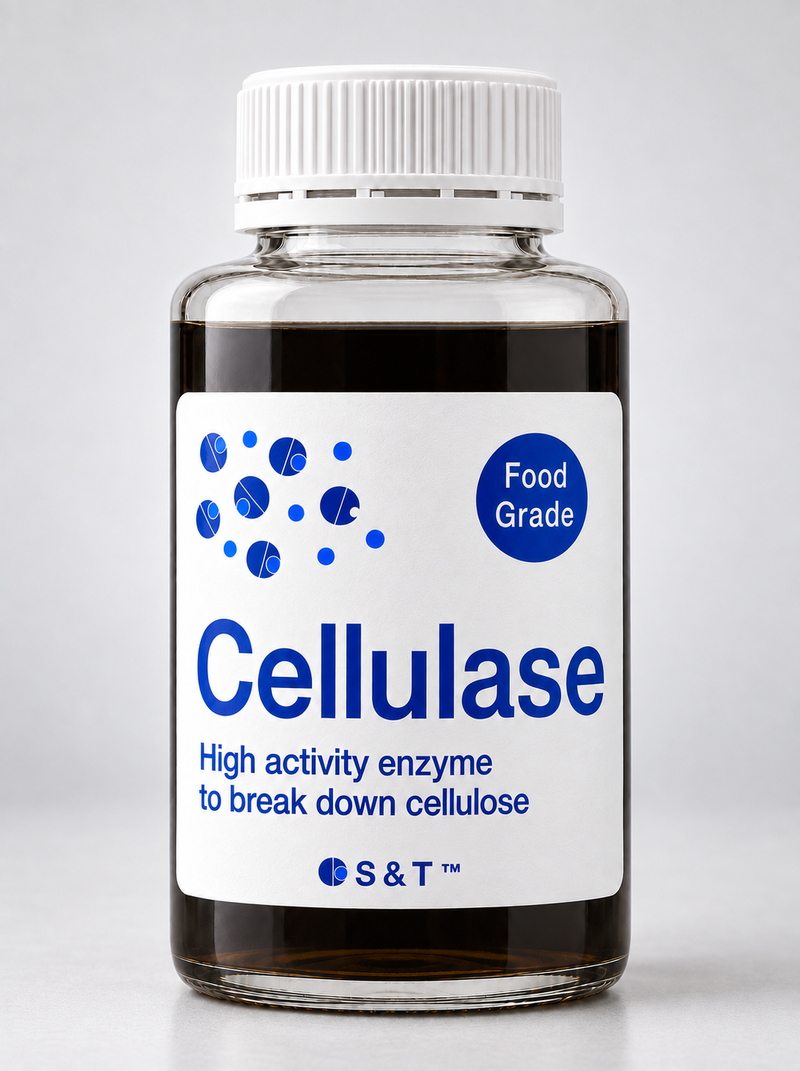
Cellulase · liquid preparation
Food-grade enzyme preparation for cellulose-processing applications.
- Listed activity: >15,000 U/g
- Listed optimum: pH 3.5–5.5; 37–55°C
- Pack options: 100 mL, 1 L, 10 L and 25 L
Product information checked 23 September 2026. Current price, availability, specifications and purchase options are shown on the product page.