Food processing and cleaning

Catalase for Residual Hydrogen Peroxide: Verification and Trial Design

How do you remove residual hydrogen peroxide with catalase? Set up compatible process controls, measure peroxide clearance and verify the endpoint.
Catalase for Residual Hydrogen Peroxide: Verification and Trial Design

Choose the right enzyme

FeedstockProcessing targetEnzyme to investigateWhat to measure
Liquid process streamRemove measurable residual peroxideCatalase liquidPeroxide concentration versus time
Dry blending or prepared solutionPrepare a controllable catalase additionCatalase powderActivity after reconstitution and residual peroxide

Trial directions depend on the supplied grade and process. Confirm conditions and use the same feedstock lot for comparison.

Plan the process

  1. 1

    Set a limit

    Choose the application-specific residual peroxide limit and a validated assay with sufficient sensitivity.

  2. 2

    Check compatibility

    Measure starting peroxide, pH and temperature and verify the selected catalase grade.

  3. 3

    Run a time course

    Compare no-enzyme and graded treatments with controlled mixing and oxygen venting.

  4. 4

    Confirm clearance

    Test residual peroxide with matrix recovery and check the downstream product.

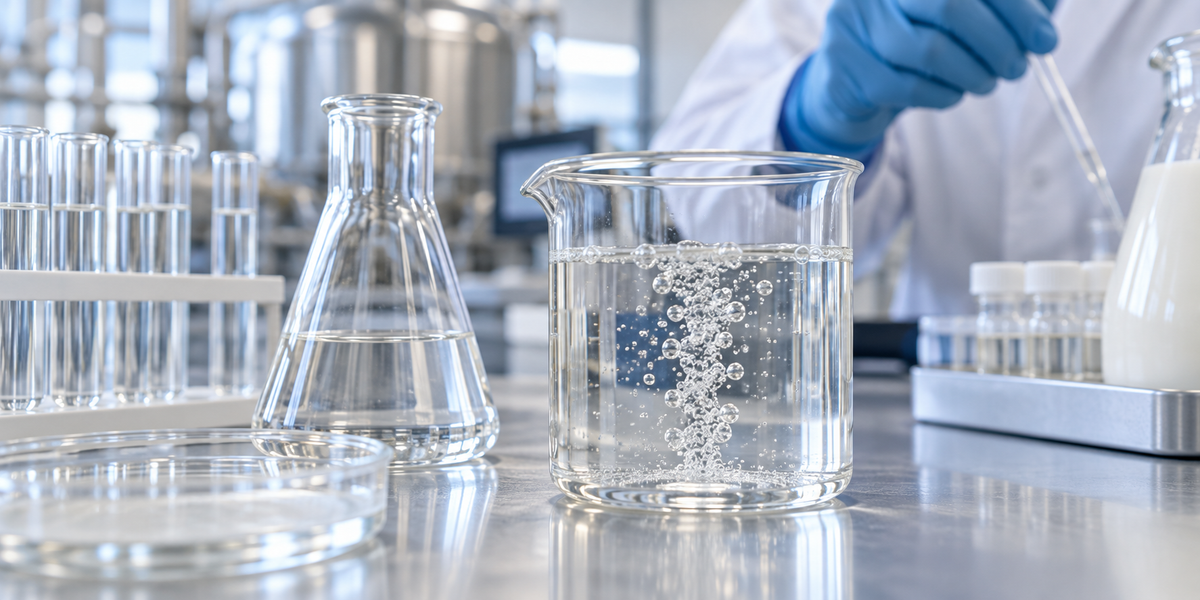
Catalase decomposes hydrogen peroxide to water and oxygen. It can help remove residual peroxide after an approved processing step, but the target residual and analytical method must be set for the actual application. Treat the enzyme step as a measured process operation rather than a visual bubble test.

How the enzyme works

The reaction produces oxygen gas, so vessel headspace and venting matter. A strong initial bubble response confirms reaction but does not prove that all peroxide has been removed. The residual oxidant, contact time and stability of the supplied catalase at process pH and temperature determine the result.

Prepare the feedstock and controls

Record starting peroxide concentration, matrix composition, pH, temperature, volume and mixing. Oxidants or detergents left from an earlier step may change enzyme activity. Select a grade with documentation appropriate for the intended use; a processing or cleaning application does not automatically establish food suitability.

Bench trial: dose, time and controls

Compare a no-enzyme control, an appropriate reference treatment and a dose series using identical initial peroxide. Dose only after confirming the mixture is within the selected grade's operating window. Mix uniformly, allow for oxygen release without pressure build-up, and collect samples at time zero and several defined intervals. Quench or analyse samples promptly using a method validated for the matrix.

What to measure

Use a quantitative residual peroxide assay with a known detection range and matrix spike recovery. Confirm the result is below the application-specific acceptance limit and repeat with new lots. Record enzyme addition, pH drift, temperature and total hold time. If downstream processing requires enzyme inactivation or removal, validate that step separately.

Set a defensible stopping point

Define the acceptable peroxide level and analytical detection limit before choosing a dose. Matrix spike recovery helps reveal assay interference, while a matched no-enzyme sample indicates peroxide loss unrelated to catalase.

Oxygen release can produce foam and pressure if confined. Introduce the enzyme at a controlled rate and verify that the vessel and venting arrangement are suitable for the actual load.

Verify downstream compatibility

After a result meets the peroxide limit, check whether residual catalase activity or formulation components affect the next processing step. Confirm the selected grade's suitability for the product and jurisdiction.

Troubleshooting

Slow removal may reflect enzyme deactivation, poor mixing or an inhibitory matrix. A falsely low assay may result from sample colour, reducing ingredients or a quench that consumes peroxide. If the reaction foams, decrease addition rate and improve venting within the process design.

Evidence and scope

These comparisons provide a development framework. Verify activity, suitability and handling against the supplied grade and confirm the measured endpoint on your feedstock before scaling the process.

Process development and supply

Share the feedstock, batch size, target specification, operating pH and temperature, intended residence time and analytical method with Scientific & Technical. The products below link to current sizes and availability. Scale only after the endpoint is reproducible on your material.

Recommended products

Choose the products that match your process. Each card explains its role in this application; you do not need every enzyme in one recipe.

Catalase
Liquid catalase

Catalase

Meter a peroxide-removal trial

  • Allow controlled oxygen release
  • Measure residual peroxide

Benefits are application targets; confirm dosage and performance in your finished formulation.

References and supporting evidence

Research and manufacturer examples support the application rationale; they do not establish identical performance for every commercial preparation.

  1. IUBMB — Catalase, EC 1.11.1.6

    Enzyme nomenclature and reaction classification; not a specification for this product.

  2. Scientific & Technical — Catalase

    Current product information; verify the grade-specific technical data.

  3. Scientific & Technical — Catalase (powder)

    Current product information; verify the grade-specific technical data.