
Enzyme science · Deep dive
DNase: structure, mechanism and industrial uses
DNA fragmentation reduces lysate viscosity and supports removal of DNA during molecular-biology and bioprocess sample preparation.
5 minute read
Recommended products →What is DNase?
DNase cleaves DNA phosphodiester bonds. Supports DNA turnover and clearance.
DNase refers to enzymes that cleave DNA. DNase I is a well-characterised endonuclease and the structural example used here; other DNases have different mechanisms and product ends.
Deoxyribonucleases participate in DNA turnover and breakdown of extracellular or unwanted DNA; DNase I is a well-characterised representative.
[3]The reaction scheme below connects starting materials and products; the active-site and energy diagrams explain the catalytic chemistry.

Essential properties and enzyme identity
| Property | Scientific detail |
|---|---|
| EC classification | EC 3.1.21.1 |
| Starting materials | DNA in aqueous solution, cell lysates or nucleic-acid preparations. |
| Products | DNA fragments with DNase-I-type ends |
| Representative molecular mass | About 29.1 kDa per deposited polypeptide for Deoxyribonuclease i from Bos taurus (PDB 3DNI). |
| Subunit organisation | DNase I is generally described as a monomer; crystal contacts are distinct from its solution-state assembly. |
| Natural sources and production | Bovine pancreas is a traditional DNase I source; recombinant production also supplies DNase I and other nucleases. |
| Key catalytic or process feature | DNase I requires divalent cations; chelation and substrate-bound proteins can strongly affect digestion. |
Discovery and scientific milestones
Early biochemical evidence
Kunitz reported isolation of crystalline deoxyribonuclease from beef pancreas in 1948, a key purification milestone recorded in the IUBMB entry.
[3]Oefner and colleagues: molecular characterisation
The 1986 structural study resolved Deoxyribonuclease i from Bos taurus, providing an experimental basis for examining its active site and substrate recognition.
[2]A therapeutic industrial application
A controlled clinical study established the effects of recombinant human DNase in cystic fibrosis; this is a distinct human enzyme preparation.
Published source ↗From natural sources to enzyme production
Bovine pancreas is the historical source of the displayed DNase I. Related enzymes occur in other organisms, while microbial nucleases can belong to different families.
Conventional production: Animal-derived DNase I is purified from pancreatic tissue; recombinant DNase is produced in a suitable expression host. Human therapeutic DNase uses mammalian cell culture, so microbial fed-batch fermentation is not a universal route.
[1]
Reaction mechanism and active site
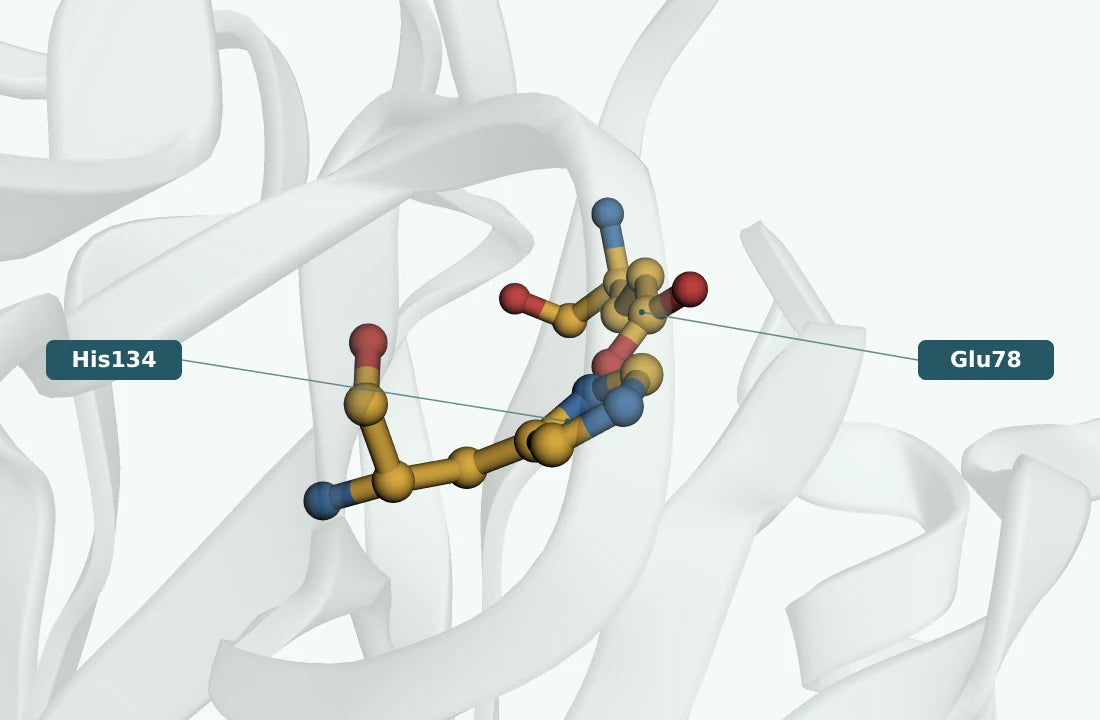
DNase I hydrolyses internal DNA phosphodiester bonds and generates fragments with 5′-phosphate and 3′-hydroxyl termini. Divalent cations support catalysis and structural stability, with cleavage behaviour depending on ionic conditions. DNA accessibility and protein binding affect digestion. The DNase I model should not be generalised to acid DNases or unrelated microbial nucleases.
- 1
Bind accessible DNA under suitable ionic conditions
- 2
Hydrolyse internal phosphodiester bonds
- 3
Release shorter DNA fragments with defined termini
DNase I requires divalent cations; chelation and substrate-bound proteins can strongly affect digestion.
[2][3]Kinetics and catalytic performance
DNA length, topology and metal-ion conditions affect the measured rate. Hyperchromicity, fragment-size distribution and acid-soluble nucleotides represent different digestion endpoints.
| Metric | Published range / example | Meaning and practical use |
|---|---|---|
| Kₘ | No matched published range included. | Substrate concentration at half Vmax for Michaelis–Menten kinetics; retain a polymer mass basis when used. |
| kcat | No matched published range included. | Turnover per active catalytic centre at saturation; Vmax divided by active-site concentration. |
| kcat/Kₘ | No matched published range included. | Low-substrate catalytic efficiency; compare the same substrate and conditions. |
| Vmax | No matched published range included. | Saturation rate for the stated enzyme loading; a protein-normalised value is identified by its units. |
| Specific activity | Assay- and loading-dependent; no intrinsic range. | Activity per mg protein under the specified assay; not necessarily a saturation rate. |
| v₀ | Assay- and loading-dependent; no intrinsic range. | Initial rate at the tested concentrations; changes with enzyme and substrate loading. |
Activity units: from measurement to useful conversion
| Measurement | Meaning |
|---|---|
| Typical activity definition | Worthington's Kunitz-type assay defines a unit through an increase of 0.001 absorbance at 260 nm per minute per mL at pH 5.0 and 25°C with specified DNA. Other digestion units use a defined mass of DNA and incubation time. |
| What the process measurement reveals | Residual DNA, fragment size and sample viscosity reveal different outcomes. An absorbance-based unit is not a micromole of DNA bonds cleaved per minute. |
| U/g and U/mL | Activity per gram or millilitre of the supplied preparation. Specific activity in U/mg protein uses a different denominator. |
Industrial applications and research opportunities
Molecular biology uses DNase for DNA removal, footprinting and controlled digestion. Bioprocessing can use nucleases to reduce nucleic-acid viscosity. Applications requiring intact RNA need a suitable RNase-contamination specification.
 01
01Nucleic-acid workflows
Remove unwanted DNA.
Measure success: Assess residual DNA and target integrity.
02Bioprocessing
Reduce DNA-associated viscosity.
Measure success: Measure rheology and downstream filtration.
03Footprinting research
Use controlled partial digestion.
Measure success: Avoid treating complete digestion as the objective.
Common questions
Can DNase I digest every DNA molecule equally?
Accessibility, protein binding and ionic conditions affect cleavage.
Does lower viscosity prove DNA is absent?
No. Short DNA fragments may remain.
Why ask about RNase contamination?
An RNA-preserving workflow requires a suitable preparation specification.
References and supporting evidence (5)
- RCSB PDB 3DNI: experimental coordinates, source and assembly
Protein-entity mass, coordinate model, experimental method and deposited biological assembly; checked 23 September 2026.
- Oefner, C.; Suck, D. (1986). Crystallographic refinement and structure of DNase I at 2 A resolution.
J.Mol.Biol. 192:605–632. Primary experimental structural publication.
- IUBMB enzyme nomenclature: EC 3.1.21.1
Accepted reaction, classification and historical bibliography.
- UniProt P00639: protein annotation
Curated protein identity and available subunit annotation;
- Worthington: DNase I Kunitz-type activity assay
Assay substrate, reporting convention and reference conditions.
Recommended products
Choose the products that match your process. Each card explains its role in this application; you do not need every enzyme in one recipe.

DNase
From £128.99
View sizes & buyBenefits are application targets; confirm dosage and performance in your finished formulation.