Biofuels

Which Cellulase is Right for My Process?

Compare endo-cellulase, exo-cellulase and liquid or powder preparations. Match enzyme activity, handling and process performance to your application.
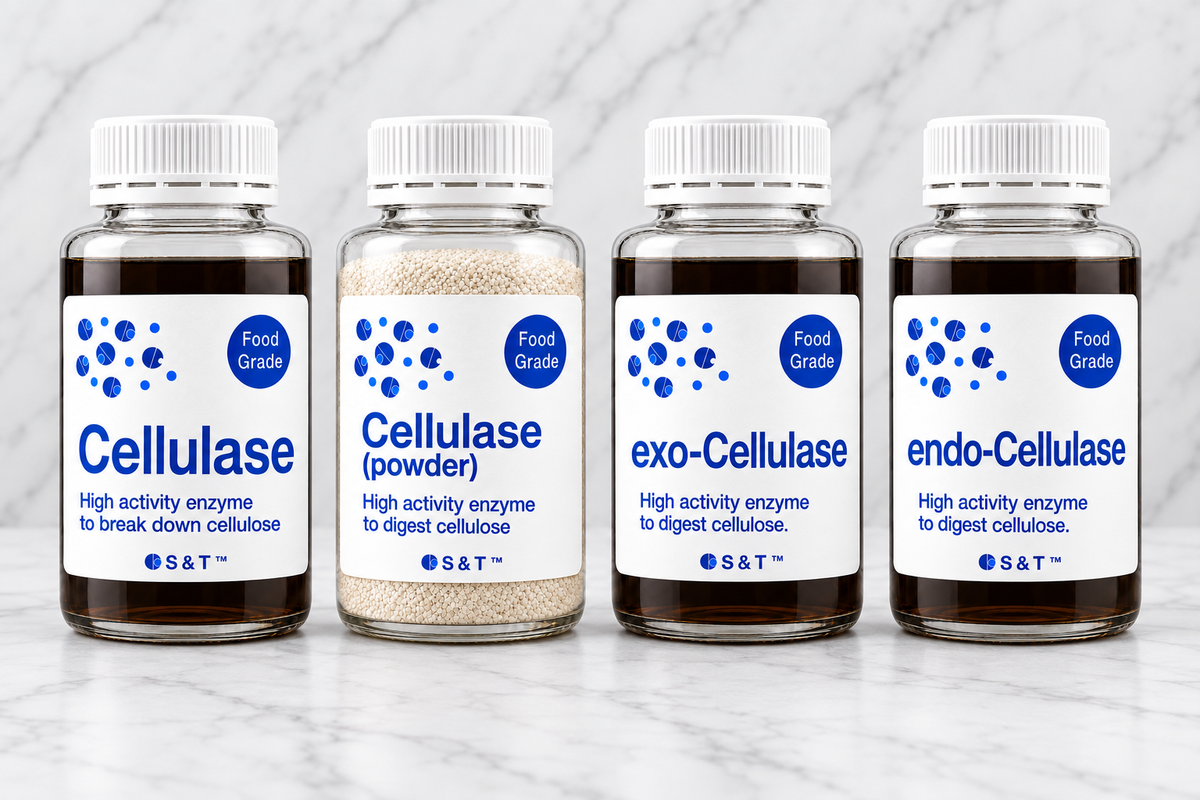
Which Cellulase is Right for My Process?

Choose the right enzyme

FeedstockProcessing targetEnzyme to investigateWhat to measure
Biomass for sugar productionExtensive cellulose hydrolysisComplementary cellulase activitiesSugar profile, conversion and cost per dry tonne
Textiles or pulp fibresControlled fibre modificationEvaluate endo-cellulase or a suitable cellulase preparationSurface change with retained fibre strength
Plant tissue for extractionRelease material from a cell-wall matrixCellulase; assess pectinase or hemicellulase as neededRecovery and final product quality
Wet process or dry formulationMatch practical handling requirementsLiquid or powder after selecting the activity profileDispersion, dosing accuracy and cost-in-use

Use this comparison to choose a trial direction. Confirm the selected grade and conditions against your feedstock; the options are not a requirement to use every enzyme.

Plan the process

  1. 1

    Define the outcome

    Decide whether you need limited fibre modification or extensive conversion to sugars.

  2. 2

    Select the activity profile

    Match endo-, exo- and complementary activities to the substrate and objective.

  3. 3

    Select the format

    Choose a practical powder or liquid formulation and confirm the grade specification.

  4. 4

    Compare in application

    Use a controlled trial and compare performance, quality and treatment cost.

Choose a cellulase by the change you need in the substrate, then choose the formulation that fits your plant. Making glucose, releasing juice and preserving useful paper fibres require different endpoints. A higher activity number or a different physical form does not by itself identify the best product.

Understand the different activities

Endo-cellulase cleaves internal bonds in accessible cellulose chains. Exo-cellulase works from accessible chain ends. Beta-glucosidase converts cellobiose to glucose. These actions can complement one another in saccharification, but their relative value depends on the substrate and desired extent of hydrolysis.

Liquid and powder describe formulation, not a catalytic mechanism. Do not assume a liquid product is endo-only, a powder is exo-only, or that either contains enough beta-glucosidase for your glucose target. Ask for the activity profile and technical data for the actual grade.

Which Scientific & Technical product should I choose?

  • Liquid cellulase: investigate when pumpable dosing and rapid distribution into a slurry are useful. Confirm performance on the target material.
  • Cellulase powder: investigate when dry formulation or handling is preferred. Plan controlled dispersion and check carrier compatibility with the product and analytical method.
  • Endo-cellulase: screen for internal chain cleavage, with a limited-treatment endpoint where fibre integrity or texture matters.
  • Exo-cellulase: assess the contribution of chain-end hydrolysis, particularly within a saccharification system. Do not treat it as a default replacement for a fibre-modification preparation.

Match the choice to the application

For biomass-to-sugar work, evaluate sugar identity and conversion, including cellobiose accumulation. For juice processing, compare recovery with clarity or cloud, flavour and filtration. For pulp and paper, assess drainage or refining alongside sheet strength and fibre yield. A preparation that wins one comparison may perform poorly against another endpoint.

Cellulase acts on beta-linked cellulosic substrates; it is not a substitute for alpha-amylase in starch liquefaction. In oat-drink development, identify whether the target is starch viscosity, sugar profile, protein behaviour or fibre modification before selecting an enzyme.

Compare technical data correctly

Request the assay substrate, pH, temperature and definition of one activity unit. Numerical U/g values from different assays are not directly interchangeable, and U/g cannot be converted to U/mL without a valid concentration or density basis. Even matched assay units do not prove equal performance on real biomass.

Confirm stability for the full process hold, formulation carriers, relevant side activities, storage conditions and compatibility with other ingredients. An operating range describes a screening boundary; it does not identify a universal optimum at every point within it.

A practical product-selection trial

  • Write a pass/fail specification before dosing: for example, a target sugar yield, juice recovery or drainage result with a minimum strength requirement.
  • Prepare representative material from one lot and retain an untreated control. Keep dry solids, pH, temperature, mixing and sampling consistent.
  • Obtain starting doses for each grade separately. Screen 0.5×, 1× and 2× of each proposed dose instead of assuming equal volumes are equivalent.
  • Compare individual preparations first. Test a combination only when each component has a defined purpose, and compare its cost and outcome with the simpler treatment.
  • Repeat the best conditions on additional feedstock lots and at realistic process solids and residence time.

Dose calculations and fair costing

For a dose of d g product/kg dry substrate and M kg dry substrate, product requirement is d × M g. At a hypothetical 1 g/kg on 50 kg dry substrate, the requirement is 50 g; this is not a recommended dose.

If dosing by activity, divide the required total units by the preparation's stated units/g, using the same assay basis. Compare cost per acceptable batch or unit of recovered product, including heating, holding and separation costs. Price per kilogram of enzyme alone can reverse the practical ranking.

Troubleshooting a misleading comparison

  • The highest activity product performs poorly: check assay relevance and substrate accessibility before concluding the product is inactive.
  • Powder and liquid appear different at equal addition: standardise the dose basis and examine carriers, dispersion and sample blanks.
  • A combination shows no extra value: test whether the second activity addresses a real limitation or simply increases total enzyme loading.
  • A good bench result disappears in production: review mixing, residence-time distribution, thermal history and feedstock variation.

Evidence and scope

Enzyme nomenclature explains catalytic roles; supplier documents describe the preparation being purchased. Neither replaces an application trial. Use the linked application guides for their distinct measurement endpoints, and select the grade that meets your actual specification at an acceptable total cost.

Cellulase for Biomass Hydrolysis

Cellulase for Fruit Juice Processing

Cellulase for Paper Manufacturing and Recycling

Cellulases for Biofuels

Process development and supply

Share your feedstock, batch size, solids loading, temperature and pH profile, available treatment time and target specification with Scientific & Technical. These details help match a preparation and starting trial dose to your process. Select the relevant products below to view bottle sizes, current pricing and availability, and buy online.

Use the current technical and safety data sheets for the supplied grade. Avoid enzyme dust and aerosols, and confirm storage and handling requirements before preparing trial solutions.

Recommended products

Choose the products that match your process. Each card explains its role in this application; you do not need every enzyme in one recipe.

Cellulase
Liquid preparation

Cellulase

Simplify wet-process dosing

  • Pumpable format for controlled addition
  • Screen substrate performance before scale-up
Cellulase (powder)
Powder preparation

Cellulase (powder)

Match a dry formulation workflow

  • A physical format rather than a separate mechanism
  • Account for carrier, dispersion and dust control
exo-Cellulase
Exoglucanase

exo-Cellulase

Select chain-end hydrolysis

  • Assess for more extensive cellulose conversion
  • Combine activities when the substrate requires it
endo-Cellulase
Endoglucanase

endo-Cellulase

Select internal chain cleavage

  • Useful for controlled cellulose modification trials
  • Creates additional accessible chain ends

From £138.99

View sizes & buy

Benefits are application targets; confirm dosage and performance in your finished formulation.

References and supporting evidence

Research and manufacturer examples support the application rationale; they do not establish identical performance for every commercial preparation.

  1. IUBMB — Cellulase, EC 3.2.1.4

    Reaction classification for internal cleavage of accessible beta-glucan chains.

  2. Scientific & Technical — Cellulase product specification

    Current supplier listing and product documentation for the liquid preparation. Use the specification for the actual grade supplied.