
Detergent formulation
Liquid, Powder or Granulate Enzymes for Detergents?
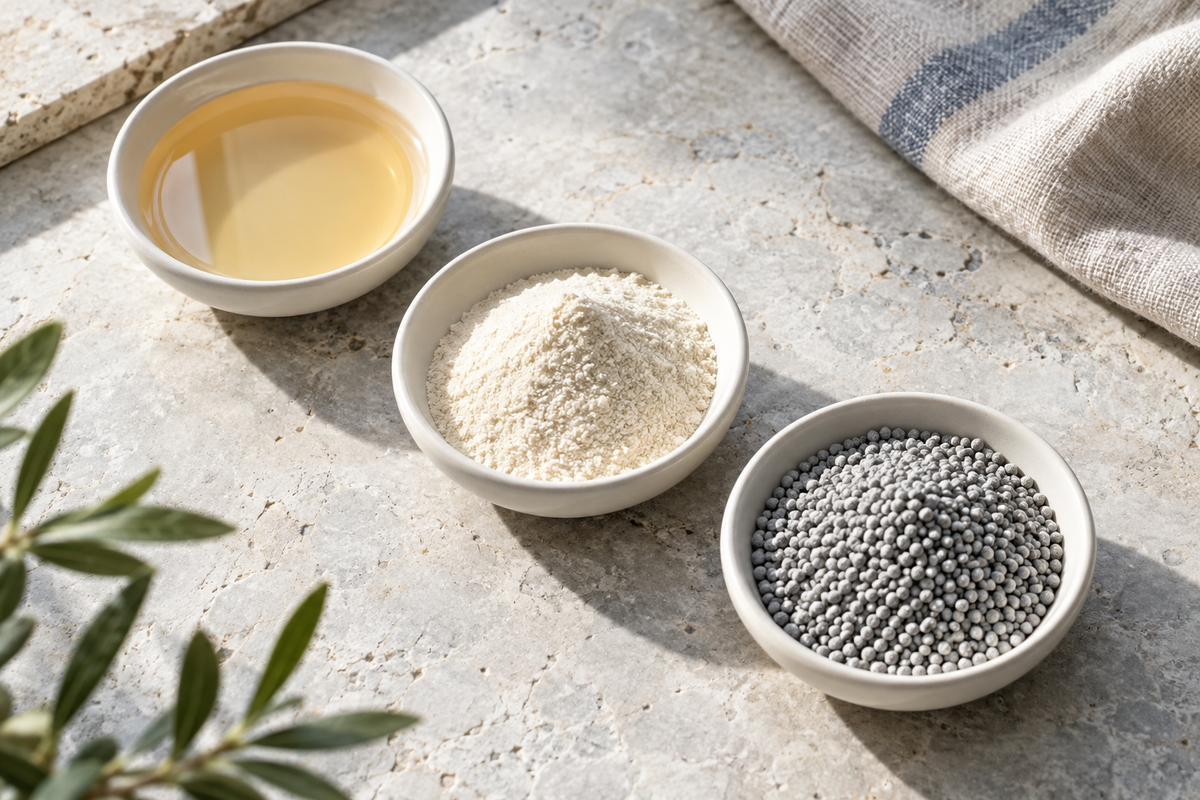
Compare liquid, cellulose powder and TiO2 granulate detergent enzymes. Match activity to stain type and test release, storage and wash performance.
Choose the right enzyme
| Feedstock | Processing target | Enzyme to investigate | What to measure |
|---|---|---|---|
| Liquid detergent | Evaluate metered protease addition | Eco detergent Protease | Protein stain removal and storage |
| Dry cellulose-carrier formulation | Target selected or mixed soils | Cellulose powder enzymes | Release, performance and residue |
| Granulate formulation | Assess dry incorporation | TiO2 granulate enzymes | Handling, dispersion and stored activity |
These comparisons identify useful development endpoints; they are not universal dose or operating-condition recommendations.
Plan the process
- 1
Define the stain panel
Define the detergent format, wash conditions and separate stain endpoints.
- 2
Compare formats
Compare relevant liquid, powder or granulate candidates at a documented activity or commercial dose basis.
- 3
Measure wash results
Measure release, stain removal, rinsing and residue in the actual wash programme.
- 4
Test after storage
Store the complete formulations under relevant conditions and repeat the wash comparison.
Recommended products
Choose the products that match your process. Each card explains its role in this application; you do not need every enzyme in one recipe.

Protease (eco detergent)
Target protein-rich soils
- Evaluate metered protease addition in the full formula
- Check wash results after concentrate storage
From £74.99
View sizes & buy
Protease (TiO2 granulate)
Evaluate a dry protein-stain component
- Test granule release at the wash dilution
- Compare stored cleaning performance and residue
From £82.99
View sizes & buy
Amylase (TiO2 granulate)
Target starch-rich stains
- Test release and access to aged starch soil
- Measure removal after the complete wash and rinse
From £54.99
View sizes & buy
Lipase (TiO2 granulate)
Target susceptible fatty soils
- Compare grease removal in the intended dry formulation
- Check rinse performance and stored activity
From £74.99
View sizes & buy
Detergent Enzymes Blend (TiO2 granulate)
Screen mixed-soil cleaning
- Evaluate complementary activities across a stain panel
- Check dispersion, residue and storage performance
From £74.99
View sizes & buy
Detergent Enzyme Blend (cellulose powder)
Assess a mixed-soil dry format
- Test release in the complete detergent
- Compare stain-panel results and retained performance
From £74.99
View sizes & buy
Lipase (cellulose powder)
Evaluate a dry fat-soil component
- Check dispersion and carrier contribution
- Measure grease removal and redeposition
From £74.99
View sizes & buy
Protease (cellulose powder)
Evaluate a dry protein-soil component
- Confirm uniform addition and release
- Compare cleaning after realistic storage
From £74.99
View sizes & buyBenefits are application targets; confirm dosage and performance in your finished formulation.
References and supporting evidence
Research and manufacturer examples support the application rationale; they do not establish identical performance for every commercial preparation.
- Scientific & Technical — Protease (eco detergent)
Current product information; confirm the technical sheet, intended-use documentation and lot specification for the supplied preparation.
- Scientific & Technical — Protease (TiO2 granulate)
Current product information; confirm the technical sheet, intended-use documentation and lot specification for the supplied preparation.
- Scientific & Technical — Amylase (TiO2 granulate)
Current product information; confirm the technical sheet, intended-use documentation and lot specification for the supplied preparation.
- Scientific & Technical — Lipase (TiO2 granulate)
Current product information; confirm the technical sheet, intended-use documentation and lot specification for the supplied preparation.
- Scientific & Technical — Detergent Enzymes Blend (TiO2 granulate)
Current product information; confirm the technical sheet, intended-use documentation and lot specification for the supplied preparation.
- Scientific & Technical — Detergent Enzyme Blend (cellulose powder)
Current product information; confirm the technical sheet, intended-use documentation and lot specification for the supplied preparation.
- Scientific & Technical — Lipase (cellulose powder)
Current product information; confirm the technical sheet, intended-use documentation and lot specification for the supplied preparation.
- Scientific & Technical — Protease (cellulose powder)
Current product information; confirm the technical sheet, intended-use documentation and lot specification for the supplied preparation.