


Couldn't load pickup availability
DNase: High activity enzyme to digest DNA
Applications: include: Cleaning, Viscosity Reduction, Filtrations, Protein Purification, Texture Control, Biofilm Control, Pharmaceutical.
Properties: Our food-grade DNase is a powerful processing aid that delivers measurable value across fermentation, food production, and sanitation workflows. By efficiently degrading DNA released during cell lysis, it significantly reduces viscosity in fermentation broths, improving mixing, pumping, and overall process efficiency in industries like brewing, bioethanol, and ingredient manufacturing. It also enhances filtration and clarification by minimising fouling, enabling faster throughput and lower operating costs. In protein and yeast extract production, DNase supports higher purity and better yields, while contributing to consistent texture and product quality. Beyond processing, it plays a critical role in facility hygiene by breaking down extracellular DNA in biofilms, strengthening cleaning protocols and reducing contamination risks. From beverages to bioprocessing, a high-performance food-grade DNase is not just an enzyme, it’s a strategic tool for improving efficiency, quality, and compliance across the entire production chain.
Reaction:
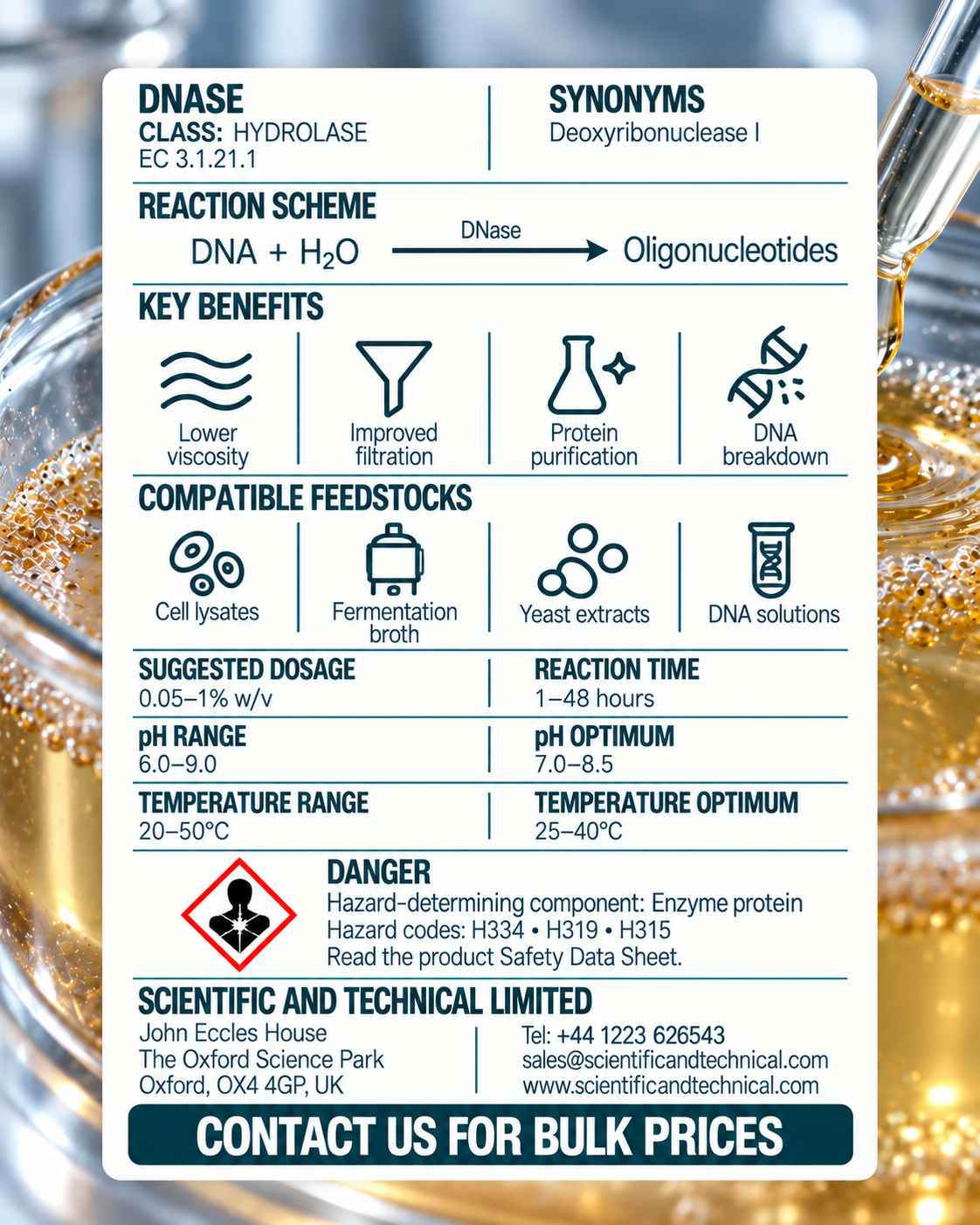
DNA + H2O → Oligonucleotides and Nucleobases
- Activity: 50,000 U/g
- Certification: Food grade, ISO 22000
- Format: Powder
- Cofactors: Magnesium or Calcium ions
- Temperature Range: 20–50°C
- Optimal Temperature: 25–40°C
- pH Range: 6.0–9.0
- Optimal pH: 7.0–8.5
- Typical Dosage: 0.1–1% w/v
- Storage: 12 months


Supporting technical guides

Bioprocessing and clarification
DNase for Viscosity Reduction: Cofactors, Mixing and Filtration
Use DNase trials to investigate DNA-related viscosity and filtration. Check cofactors, chelators, mixing and target-product recovery with matched controls.
Read technical guide
Enzyme science · Deep dive
DNase: structure, mechanism and industrial uses
DNA fragmentation reduces lysate viscosity and supports removal of DNA during molecular-biology and bioprocess sample preparation.
Read technical guide