
Bioethanol and starch processing
Enzymes for Starch Bioethanol: Corn, Grain and Potato Conversion
Compare corn, grain and potato enzyme blends for bioethanol. Assess starch preparation, glucose release and fermentation on a dry-feedstock basis.
Choose the right enzyme
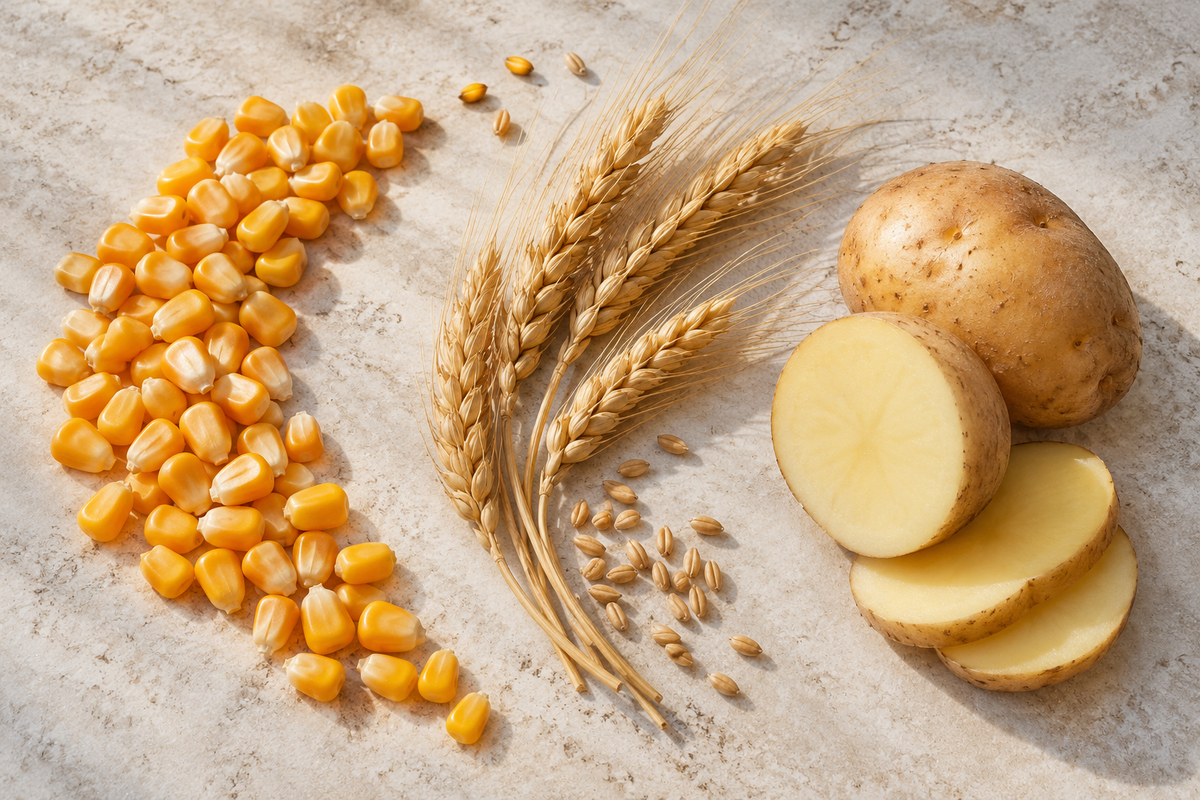
| Feedstock | Processing target | Enzyme to investigate | What to measure |
|---|---|---|---|
| Corn meal | Convert starch-rich solids | Corn Max Yield Pro | Glucose and ethanol per dry mass |
| Mixed cereal grain | Account for starch and fibre | Grain Max Yield Pro | Residual starch and fermentation |
| Potato residues | Correct for moisture variation | Potato Max Yield Pro | Dry-basis recovery and viscosity |
These comparisons identify useful development endpoints; they are not universal dose or operating-condition recommendations.
Plan the process
- 1
Measure dry solids
Prepare a representative feedstock lot and record dry matter, starch content and particle size.
- 2
Prepare the starch
Apply the same preparation step to treatment and control, then cool to a supported blend addition condition.
- 3
Compare conversion
Compare supplier-supported doses and sample for glucose, viscosity and residual starch over time.
- 4
Confirm fermentation
Ferment matched hydrolysates and calculate ethanol recovery and process cost per dry-feedstock basis.
Recommended products
Choose the products that match your process. Each card explains its role in this application; you do not need every enzyme in one recipe.

Corn Max Yield Pro
Screen a corn-focused blend
- Address prepared starch-rich feedstock
- Measure sugar and ethanol recovery per dry mass
From £129.99
View sizes & buy
Grain Max Yield Pro
Evaluate mixed-grain processing
- Account for starch and cell-wall limitations
- Compare fermentation at matched dry solids
From £108.99
View sizes & buy
Potato Max Yield Pro
Develop a potato-residue process
- Correct additions for variable moisture
- Track viscosity and dry-basis recovery
From £108.99
View sizes & buyBenefits are application targets; confirm dosage and performance in your finished formulation.
References and supporting evidence
Research and manufacturer examples support the application rationale; they do not establish identical performance for every commercial preparation.
- IUBMB enzyme nomenclature — EC 3.2.1.1
Reaction classification supporting the mechanism discussed; a family example where applicable, not confirmation of the supplied preparation’s exact activity profile or process settings.
- IUBMB enzyme nomenclature — EC 3.2.1.3
Reaction classification supporting the mechanism discussed; a family example where applicable, not confirmation of the supplied preparation’s exact activity profile or process settings.
- Scientific & Technical — Corn Max Yield Pro
Current product information; confirm the technical sheet, intended-use documentation and lot specification for the supplied preparation.
- Scientific & Technical — Grain Max Yield Pro
Current product information; confirm the technical sheet, intended-use documentation and lot specification for the supplied preparation.
- Scientific & Technical — Potato Max Yield Pro
Current product information; confirm the technical sheet, intended-use documentation and lot specification for the supplied preparation.