


Couldn't load pickup availability
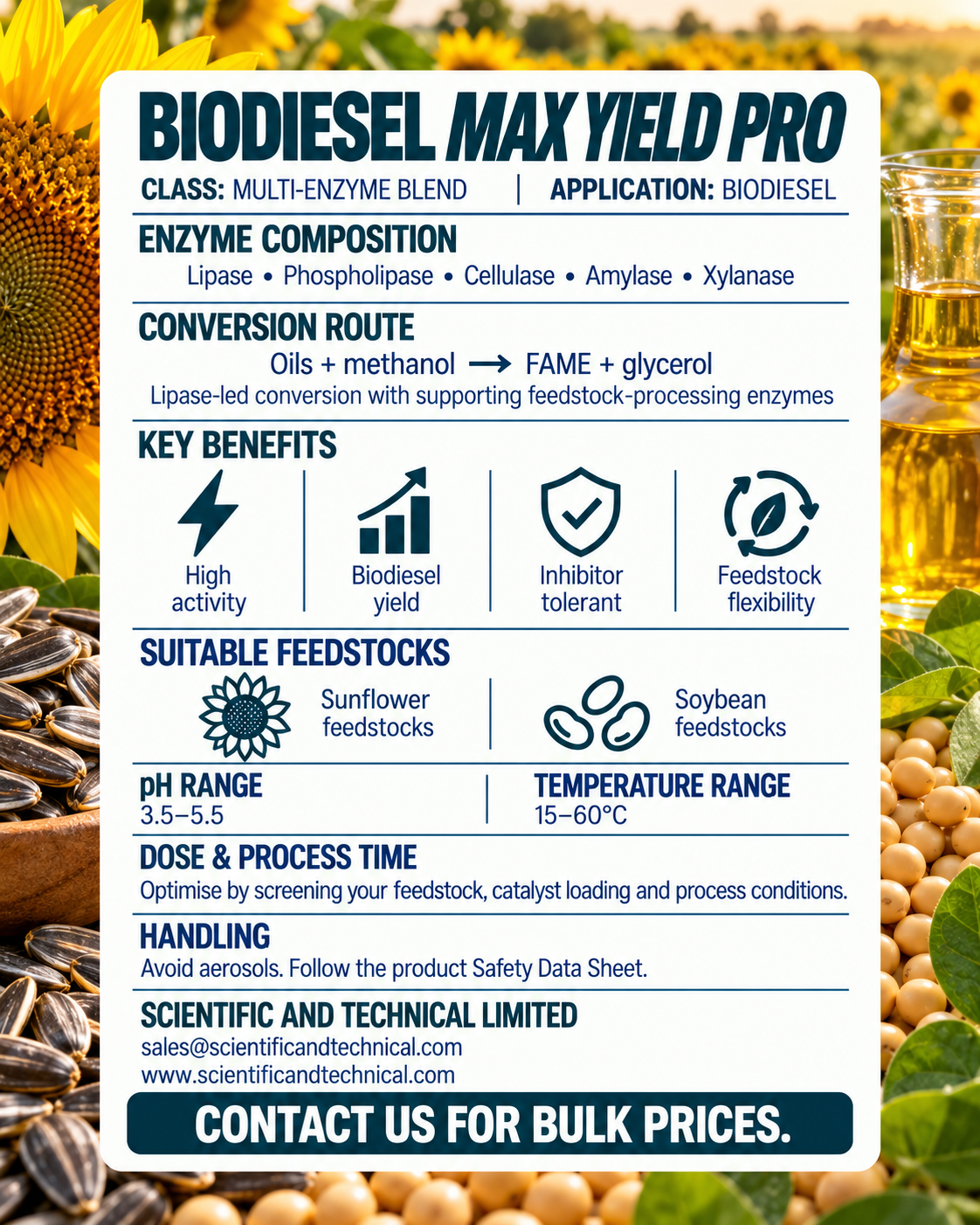
Biodiesel Max Yield Pro
Experimentally derived formulation enabled by high-throughput screening
Applications: include: Biofuels, Recycling, Biogas.
Key properties: Specially blended formulation to transform your sunflower / soy bean biodiesel yields whilst preventing inhibitor issues.
Overview: Using enzymes to convert sunflower and soy bean feedstocks into biodiesel offers a highly efficient and environmentally sustainable alternative to traditional chemical processes. Enzymatic conversion, primarily driven by lipase enzymes, enables the mild and selective transformation of sunflower oil into fatty acid methyl esters (FAMEs)—the key components of biodiesel—without generating soap or toxic by-products. This biocatalytic approach operates under low temperature and neutral pH conditions, reducing energy consumption and equipment corrosion while allowing the use of unrefined or high free fatty acid (FFA) oils that would otherwise be unsuitable for alkaline catalysis. In integrated biorefinery systems, additional enzymes such as cellulase and hemicellulase can hydrolyse sunflower hulls and meal into fermentable sugars to support microbial lipid production, further enhancing resource utilization. Overall, enzymatic biodiesel production from sunflower feedstocks delivers higher yields, cleaner processing, and improved feedstock flexibility, making it a sustainable and economically viable pathway for renewable fuel generation.
- Certification: Biofuel Grade
- Enzymes: Lipase, Phopholipase, Cellulase, Amylase, Xylanase
- Temperature Range: 15–60°C
- pH Range: 3.5–5.5
- Inhibitor Compatibility: High tolerance
Cellulase scientific deep dive
Explore cellulase EC numbers, molecular properties, reaction mechanisms, natural sources and industrial applications, with an interactive protein structure and scientific references.
Application guides


Supporting technical guides

Biodiesel and oil conversion
Lipase for Biodiesel: Water, Alcohol Addition and FAME Analysis
Plan lipase biodiesel trials around oil quality, water balance and staged alcohol addition. Measure FAME and residual glycerides before scale-up.
Read technical guide
Enzyme science · Deep dive
Enzyme blends: structure, mechanism and industrial uses
Formulated blends combine selected activities to address multiple bonds or sequential reaction steps in food, cleaning and biomass processes.
Read technical guide
Enzyme science · Deep dive
Lipase: structure, mechanism and industrial uses
Hydrolysis produces fatty acids, while controlled low-water reactions enable ester synthesis, interesterification and biodiesel-related conversions.
Read technical guide
Enzyme science · Deep dive
Phospholipase: structure, mechanism and industrial uses
Selected activities support oil degumming, production of modified lecithins and adjustment of phospholipid functionality in foods.
Read technical guide
Enzyme science · Deep dive
Alpha-amylase: structure, mechanism and industrial uses
Rapid internal chain cleavage makes starch slurries easier to pump and prepares them for brewing, glucose production, cereal drinks and removal of starch-based stains.
Read technical guide
Enzyme science · Deep dive
Xylanase: structure, mechanism and industrial uses
Cleaving the xylan backbone supports cereal processing, dough modification, pulp treatment and access to fermentable biomass carbohydrates.
Read technical guide