


Couldn't load pickup availability
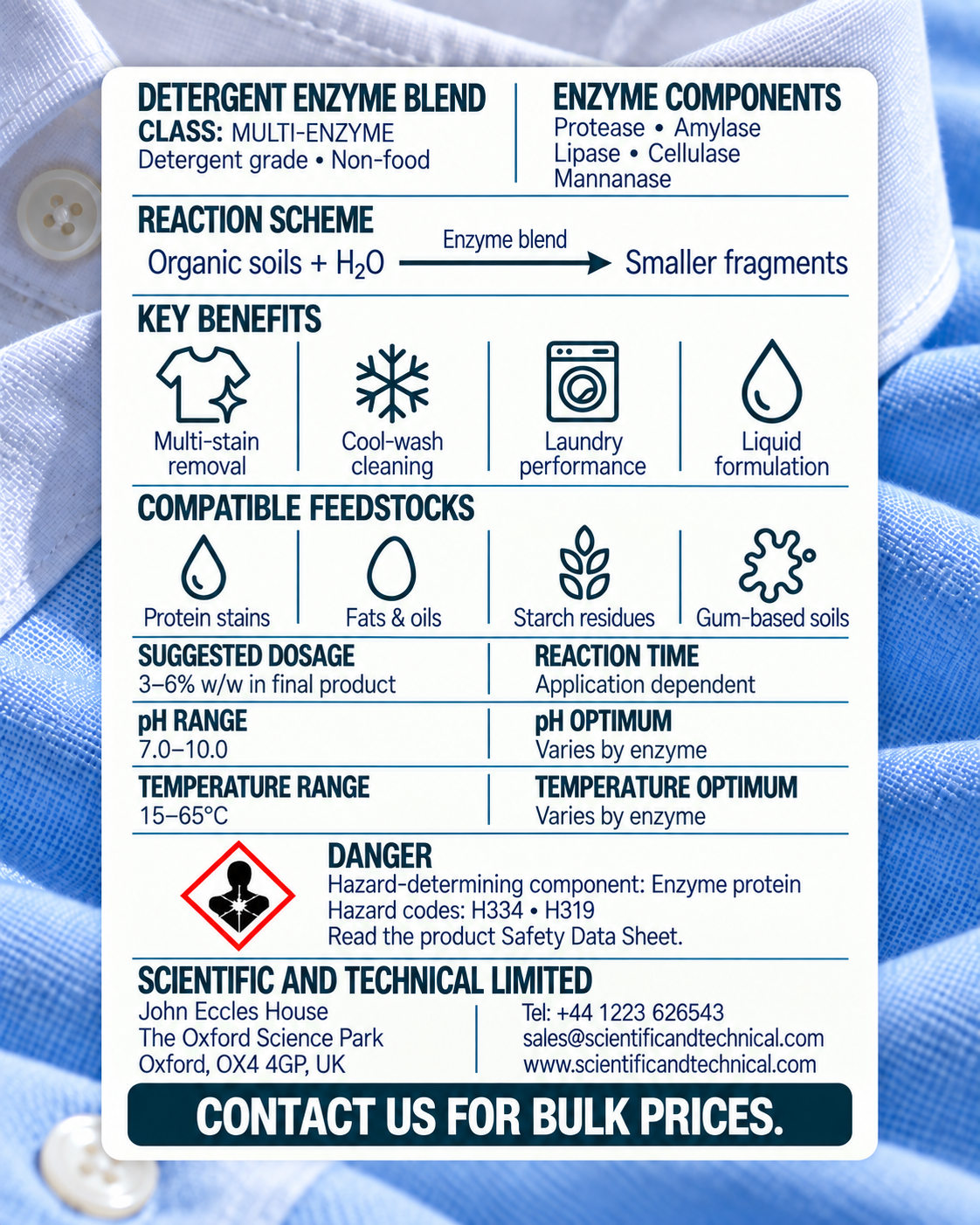
Detergent Enzymes: Premium blend of 5x high activity detergent grade enzymes concentrate.
Applications: Industrial Cleaning, Washing, Washing Machines, Fabrics & Textures.
Properties: Detergent Enzymes is a powerful formulation designed for superior cleaning performance across a wide range of applications. This advanced concentrate, multi-enzyme complex includes proteases, lipases, amylases, mannanases and cellulases, working synergistically to break down proteins, fats, starches, and cellulose-based residues with exceptional efficiency. Key benefits include enhanced stain removal, deep cleaning at low temperatures, and environmental friendliness due to its biodegradable and non-toxic nature. Ideal for industrial machine cleaning, laundry detergents, food processing sanitation, and medical instrument cleaning, this enzyme blend ensures optimal performance, reduced chemical usage, and improved sustainability for high-demand cleaning operations.
- Enzymes: Amylase, Cellulase, Protease, Mannanase, Lipase
- Suggested final product dosage: 3-6% w/w
- Certification: Detergent grade, non-food
- Temperature Range: 15–65 degrees
- pH Range: 7.0–10
- Shelf life: 12 months
Cellulase scientific deep dive
Explore cellulase EC numbers, molecular properties, reaction mechanisms, natural sources and industrial applications, with an interactive protein structure and scientific references.


Supporting technical guides

Cleaning
Which Enzymes Do I Need for a Detergent Formulation?
Match protease, amylase, lipase and mannanase to cleaning targets, then test compatibility and storage stability in your detergent formulation.
Read technical guide
Cleaning
Lipase for Grease Removal: Choosing and Testing a Cleaning Enzyme
Evaluate detergent lipase for fatty soils with controlled wash tests. Learn which grease types to check and how formulation affects the result.
Read technical guide
Cleaning
Amylase for Starch Stains: A Detergent Development Guide
Test detergent amylase on starch-based food residues. Compare cooking history, wash conditions, enzyme dose and finished-formulation stability.
Read technical guide
Enzyme science · Deep dive
Enzyme blends: structure, mechanism and industrial uses
Formulated blends combine selected activities to address multiple bonds or sequential reaction steps in food, cleaning and biomass processes.
Read technical guide
Enzyme science · Deep dive
Alpha-amylase: structure, mechanism and industrial uses
Rapid internal chain cleavage makes starch slurries easier to pump and prepares them for brewing, glucose production, cereal drinks and removal of starch-based stains.
Read technical guide
Enzyme science · Deep dive
Protease: structure, mechanism and industrial uses
They turn protein-rich feedstocks into peptides with different solubility, flavour and functional properties, and break down protein soils during cleaning.
Read technical guide
Enzyme science · Deep dive
Mannanase: structure, mechanism and industrial uses
Reducing mannan chain length supports viscosity control, coffee extraction, feed processing and production of manno-oligosaccharides.
Read technical guide
Enzyme science · Deep dive
Lipase: structure, mechanism and industrial uses
Hydrolysis produces fatty acids, while controlled low-water reactions enable ester synthesis, interesterification and biodiesel-related conversions.
Read technical guide