


Educational Enzyme Kit - Amylase
Educational Enzyme Kit - Amylase
Free delivery on orders over £100 equivalent
Couldn't load pickup availability
Inspire the next generation with practical enzyme science
Bring starch digestion to life with the S&T Amylase Education Kit. Students explore potato starch and crushed malt, observe iodine colour changes and learn to interpret refractometer readings through a fair comparison with a no-enzyme control.
For schools, colleges and universities. Suitable for ages 11+ with competent adult supervision.
Two substrates. Three ways to investigate.
- Potato starch: investigate amylase action on a prepared starch paste.
- Crushed malt: connect cereal processing to enzyme science and industrial applications.
- Observe and measure: compare iodine responses, changes in flow and soluble-solids readings.
Aim for a useful 5–10 minute reaction observation window after a teacher pilot. Allow additional time for preparation, cooling and discussion. Actual timing depends on enzyme activity, dose and conditions; a higher dose should be piloted before class.
Inside the boxed kit
- 100 mL amylase enzyme.
- 100 mL Lugol’s iodine solution.
- 200 g potato starch and 200 g crushed malt.
- 1 portable refractometer.
- 1 × 500 mL beaker.
- 3 measuring spoons and 3 × 3 mL Pasteur pipettes.
- 3 six-well sampling trays.
- Step-by-step instructions and an A4 educational poster.
Download the illustrated experiment guide
Download the 14-page Amylase Education Kit Guide (PDF)
The revised guide covers amylase in nature, the chemical reaction, industrial applications, starch and malt experiments, matched controls, six-well sampling, refractometer technique, a new illustrated cover, a portrait action poster on page two, clearly annotated reaction-profile graphs with arrowed axes, a redesigned discovery poster connecting seed growth, food, industry, recycling and biofuels with a clearly labelled reaction, a student results sheet, teacher preparation notes and a teacher answer key on the final two pages.
Read the evidence correctly: iodine indicates starch-chain structure. °Brix is a sucrose-equivalent soluble-solids reading, not a glucose-specific measurement or a guaranteed sugar yield.
Read the phone- and tablet-friendly guide online · Download the A4 amylase poster (PDF)
Prepare your class
Arrange a second heat-resistant beaker for a paired control, temperature measurement, a timer, water, suitable mixing equipment and any additional apparatus listed in the guide. One kit contains one beaker and one refractometer; additional equipment is needed for multiple simultaneous groups.
An adult handles boiling water. Cool mixtures to the selected working temperature before adding enzyme. Follow the supplied batch label, technical sheet and current safety data sheets for enzyme conditions, iodine working strength, storage and disposal. Wear eye protection, suitable gloves and a laboratory coat.
Explore teaching resources and practical calculators.
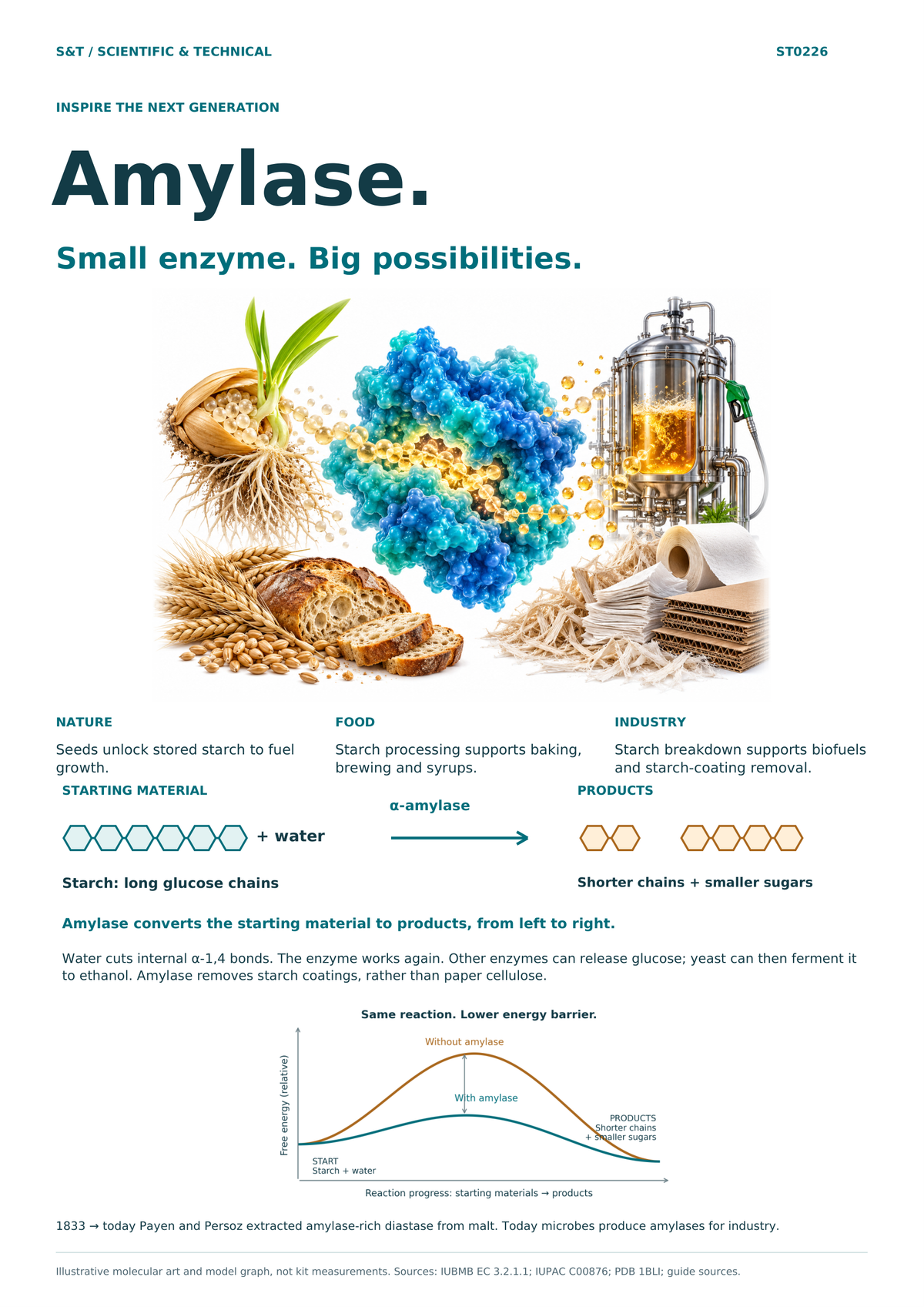
Amylase: tiny enzyme, big possibilities
Explore the illustrated classroom discovery poster: starch hydrolysis, illustrative molecular artwork, enzyme action, history, food, paper recycling and biofuels.


Supporting technical guides

Education and enzyme assays
Amylase and Starch: Designing a Clear Classroom Experiment
Plan an amylase classroom experiment with iodine controls, timed sampling and clear interpretation of starch breakdown and refractometer readings.
Read technical guide
Enzyme science · Deep dive
Alpha-amylase: structure, mechanism and industrial uses
Rapid internal chain cleavage makes starch slurries easier to pump and prepares them for brewing, glucose production, cereal drinks and removal of starch-based stains.
Read technical guide