


Couldn't load pickup availability
Applications: include: Biofuels, Recycling, Biogas.
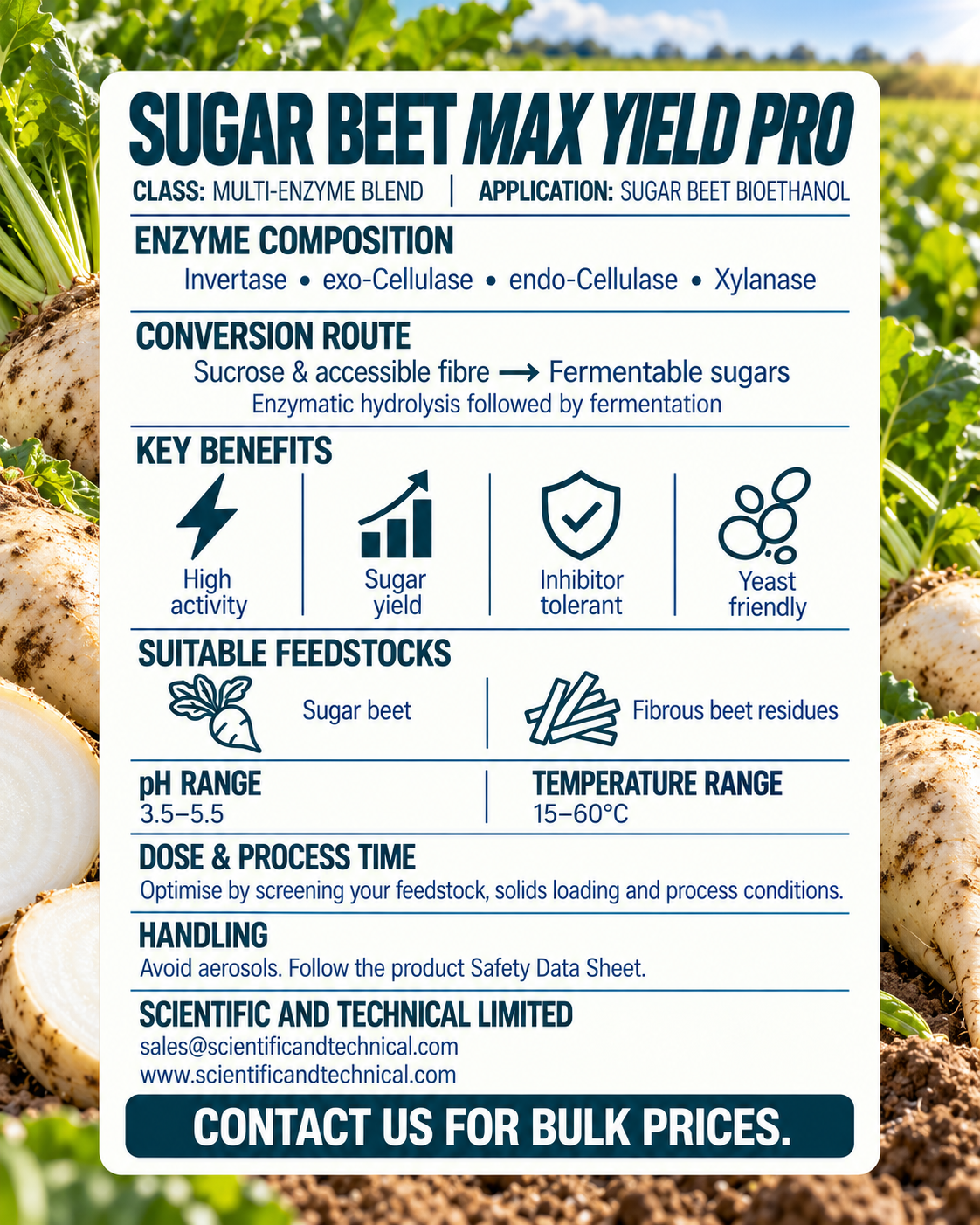
Key properties: Specially blended formulation to transform your sugar beet biofuel yields whilst preventing inhibitor issues.
Overview: Tailored enzyme blend for sugar beet conversion is designed to efficiently break down the complex carbohydrates in sugar beet, including sucrose, pectin, and residual starch, into fermentable sugars for bioethanol production. This specialised blend includes invertase, cellulase, pectinase and amylase enzymes. Invertase rapidly hydrolyses sucrose into glucose and fructose, the primary fermentable sugars. Pectinase degrades pectic substances in the beet cell walls, improving juice extraction and sugar release, while amylase targets any residual starch to maximise sugar availability. The benefits of this enzymatic approach include enhanced sugar recovery, faster processing times, improved ethanol yields, and reduced energy and chemical usage compared to conventional methods. By optimising the enzyme combination for sugar beet composition, this tailored blend enables a cost-effective, efficient, and environmentally sustainable pathway for bioethanol production from a high-sugar feedstock.
- Certification: Biofuel Grade
- Enzymes: Invertase, exo-Cellulase, endo-Cellulase, Xylanase
- Temperature Range: 15–60°C
- pH Range: 3.5–5.5
- Inhibitor Compatibility: High tolerance


Supporting technical guides

Bioethanol and sugar crops
Sugarcane and Sugar Beet Enzymes: Juice, Molasses and Fibre
Choose enzyme trials for sugarcane and sugar beet by separating sucrose-rich streams from fibrous residues. Measure sugar recovery and fermentation.
Read technical guide
Enzyme science · Deep dive
Enzyme blends: structure, mechanism and industrial uses
Formulated blends combine selected activities to address multiple bonds or sequential reaction steps in food, cleaning and biomass processes.
Read technical guide
Enzyme science · Deep dive
Invertase: structure, mechanism and industrial uses
Sucrose conversion to glucose and fructose supports invert-sugar manufacture, confectionery processing and fermentation feed preparation.
Read technical guide
Enzyme science · Deep dive
Exo-cellulase: structure, mechanism and industrial uses
Cellobiose release complements endoglucanase in biomass saccharification; beta-glucosidase then converts the cellobiose into glucose.
Read technical guide
Enzyme science · Deep dive
Endo-cellulase: structure, mechanism and industrial uses
A limited number of internal cuts can reduce viscosity, loosen fibres or remove surface fibrils before extensive sugar production occurs.
Read technical guide
Enzyme science · Deep dive
Xylanase: structure, mechanism and industrial uses
Cleaving the xylan backbone supports cereal processing, dough modification, pulp treatment and access to fermentable biomass carbohydrates.
Read technical guide